Tuesday. We have now moved our trailer to a new campsite as we are going to stay in San Antonio until Saturday.
This campground is called Travellers World and though quite expensive is very pleasant and only 10 minutes from the city centre. The sites are well sized though a little too close to each other. It has good facilities, pool, laundry, hall, library. Lots of long term snowbirds, many of whom are Canadians. Apart from the price of $37 p.n. I would recommend this campground.
Moving was hot work as the temperature climbed again to 80, so we cooled down for a bit, had some lunch and then set out to have a look at one of the other local missions. The closest one to us is San Jose Mission, just about half a mile down the road. It is a 7 acre enclosure which was started in 1720 and finished by about 1780, though it has had lots of changes to it in it's past. The mission was placed there to provide an outpost for the Spanish, as a way of converting the local Indians and giving the Indians a chance to improve their lives.
It seemed to work, but when the Spanish left in 1810's the Mexicans secularised the mission and it became a village, then a fort to keep out the Apache and Comanche Indians. Over the years it fell into disrepair but was restored in the 1930's as part of Roosevelt's WPA plan
Showing posts with label history. Show all posts
Showing posts with label history. Show all posts
Tuesday, November 23, 2010

Saturday, November 20, 2010
Remember the Alamo
We arrived in San Antonio on Friday after a difficult journey.
On Saturday we decided to take it very easy, so we decided to drive into San Antonio (we are only about 5 minutes from the centre) and found a vacant Parking Meter to park at. (Sally's disabled parking badge means no payment needed )
Then we set out to see that most famous of all historical Cliche's - The Alamo.
We had a great time as we took the audio tour and found out about how they built the Mission.
The Mission is a fascinating place. It is really old, by any standards, dating back to the 1700’s when it was built as a Spanish Mission. Because of hostile Indians, the Missions were often fortified. It is most know for the Battle of The Alamo which took place in 1835 as part of Mexico’s civil war, which in turn brought about Texas independence from Mexico in 1836. I am still not clear why Americans such as Senator Davy Crockett, Jim Bowie, Travis and John Wayne were mixed up in a foreign war, but they were. The story of the Alamo can be read in a number of places, most accessible being Wikipedia. However it remains one of the central stories of American history and the site is treated as hallowed ground by all who visit it. For us it (a) filled out a bit of America’s history, that everything West of the Louisiana Purchase was Spanish, then Mexican, for about 300 years, (b) started to place into context the relationship between U.S.A. and Mexico. It is hardly surprising that the border is so flexible as many people of Mexican origin lived in Texas from when it was part of Mexico, indeed it often appears to be more Mexico than U.S.A.
We listened to the Daughters of The Texas Revolution tour guides tell us all about the battle at The Alamo, and about the fascinating history of Mexico, then we went to see the John Wayne Collection of memorabilia from the film The Alamo.
The battle of the Alamo was about claiming equal rights with other areas of Mexico and did not solve much at all, indeed the battle was lost by the Texans. However it galvanised the area into declaring its independence from Mexico and after a couple more reversals Texas was allowed to become a separate and independent country, which it remained for some ten years before entering into the United States in 1846.
While on the tour we listened to a couple of excellent expositions from the staff at the Alamo.
After our visit there we decided to eat out, so stopped at a local steak house The Red Barn and had a very mediocre steak - still you can’t win them all.
Tuesday, November 9, 2010
Lake Charles
On Tuesday we took a ride into Lake Charles. After stopping at the Visitor Center, which was very nice, we took a self guided tour round the Charpentier Historical District. This is a district of houses which were built around the turn of the Twentieth Century. They glory in the the fact that they were not architect designed, but rather built from plans bought off the shelf, then modified by the carpenter builders of the time. There are lots of pretty houses, but nothing that you would want to have made a special journey for.
After this we were ready to eat, so we went to one of the recommended restaurants, called Shasha's. It was an OK meal, but I felt it was a little overpriced and undersized - are we getting use to the massive portions usually served do you think?
We finished off the day by getting the shopping in at a local Farmer's Basket, which is a big chain of supermarkets in this area.
In the evening we watched The Appalachians. This was the first of three programmes which we had bought when we visited The Carter Family Fold in April last year, when we were in Tennessee. Unfortunately it made us think thoughts about returning to the area, but it will probably not be for several years yet!
After this we were ready to eat, so we went to one of the recommended restaurants, called Shasha's. It was an OK meal, but I felt it was a little overpriced and undersized - are we getting use to the massive portions usually served do you think?
We finished off the day by getting the shopping in at a local Farmer's Basket, which is a big chain of supermarkets in this area.
In the evening we watched The Appalachians. This was the first of three programmes which we had bought when we visited The Carter Family Fold in April last year, when we were in Tennessee. Unfortunately it made us think thoughts about returning to the area, but it will probably not be for several years yet!
Saturday, November 6, 2010
Where Cajuns Come From.
The Cultural Center hit it just right for us as it explained the origin and history of the Acadian – Acadjian- Cajun people. They actually arrived in Acadia from France in 1604, 16 years before the Pilgrim Fathers landed further south. In the 1750’s they were forcibly removed from the land, exiled and transported to other colonies by the British in a political move that looked very much like the clearing of the crofters in Scotland and similar actions in Ireland. The area was then renamed Novia Scotia (New Scotland) by the British. Several thousands fled, or otherwise made their way to the old French Colonies on the Gulf of Mexico and a community was set up in Louisiana, separate from the New Orleans French Colonialists. In 1790 the Slave revolt in Haitti meant that some 10,000 French/black refugees fled across the gulf to Louisiana and provided the Creole influence. So there were really three different French influences all jumbled in together in the bayou areas round the lower part of the Mississippi.
You Nice people of Eunice.
Thursday, the weather has returned to sunny skies, although the temperature has dropped to the sixties and thirties at night. It now feels like the crisp autumn days back home that tell us winter is around the corner. In this case high pressure build over The Rockies and forces a cold North wind to sweep down from Canada and the Great Lakes across the Mississippi plains, right down to the Gulf of Mexico (where we are).
As it was a nice sunny day we decided to return to Eunice to see the things missed on Saturday. As we drove down we took a couple of pictures of the extensive rice fields we drove through. Many of them were still flooded for the rice in them, others were dry and bare, but with the little levees between the fields.
In Eunice we visited the Jean Lafitte Acadian Plains Cultural Center, which is a National Park. It is one of six locations which make up the park, some of them are just buildings, like this one, others are land areas which reflect the geography. There is a big bayou park near Westwego, where we camped, outside of New Orleans. There is also a park at the site of the battle between the English and Americans, which is the story of the song made so famous by Lonnie Donnegan, (UK) and Mac Wiseman (USA), The Battle of New Orleans. This battle was fought as part of the little known war between the Americans and the British in 1812-1815, where the English 10,000 troops came second to General Andy (later to be President) Jacksons 1500 assortment army, mostly militia men. It also included the famous Pirate Jean Laffite, who is a big name round Louisiana, hence the name of the National Park.
Friday, November 5, 2010
We Visit Washington
Almost every state has a Washington, either town or county named after their first president.
Louisiana is no different. We had heard that it was a quaint old town which still had a number of old houses, so we decided to give it a visit. Camilla said she would like to come along as well.
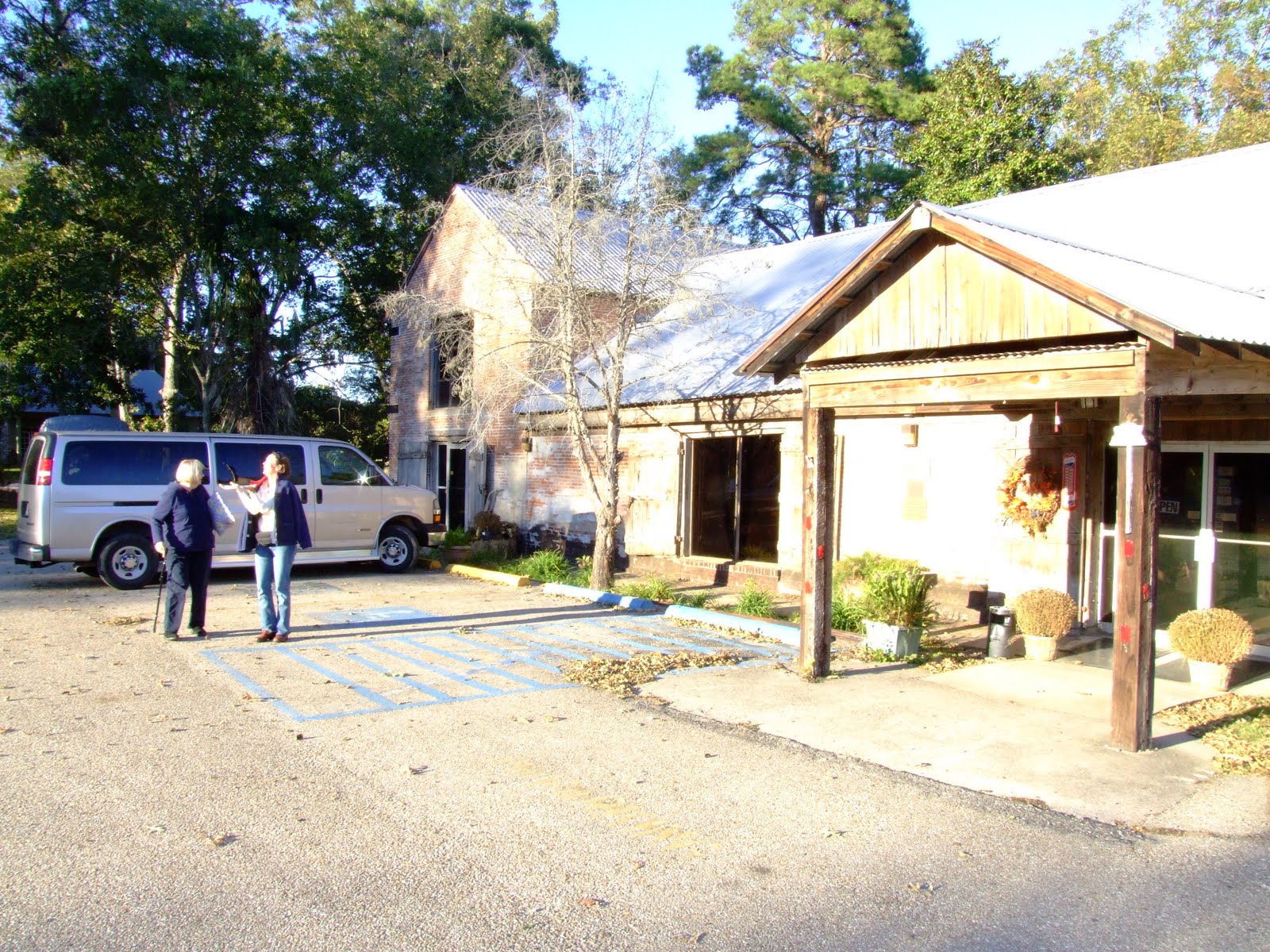
Washington has the strange characteristic of being a port almost 100 miles from the sea and its bayou is quite narrow (it's too small to call a river). It is now a small town with only a single stoplight. However it has a small museum, some very nice houses and a plantation house (Magnolia Ridge). We toured the museum and spoke to a couple of very nice guides. They told us quite a bit about cotton and rice growing.
We then understood the significance of Washington. It is the only high ground that is reachable by river on the west side of the Achafalaya Swamp area, and although the bayou is quite small it meant that it was the only way that people on the West Prairies could get their cotton and rice out and goods in, So until the arrival of the train in 1830's if was a very important port. Steam paddle boats would come in during the winter, when the bayou was at it's highest, and take away the goods.

We then toured the little town, looking at all of the very old houses. Most interesting of all was the Magnolia Ridge Plantation. It was very well preserved and had beautiful grounds, although we could not go into the the house as it is still a private dwelling place. However as we walked round we met a very nice couple who are the caretakers. They were very friendly and we stood and talked to them for about an hour.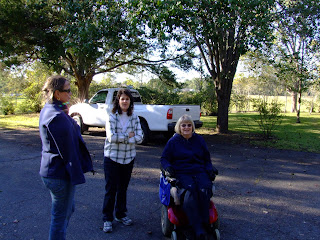
We ended up with them giving us a big bag of Pecan Nuts to take back to the trailer (this is big Pecan country, and this is the time to gather them). We then went and ate at the very posh Washington Steamboat Warehouse, which is a converted steamboat warehouse in Washington. We had a very nice, if slightly pricey, meal, Sally had Srimp Betsy (like a soup), I had Crawfish Etouffe and Camila had seafood Surprise (a pasta with a creamy seafood sauce).
Louisiana is no different. We had heard that it was a quaint old town which still had a number of old houses, so we decided to give it a visit. Camilla said she would like to come along as well.
Washington has the strange characteristic of being a port almost 100 miles from the sea and its bayou is quite narrow (it's too small to call a river). It is now a small town with only a single stoplight. However it has a small museum, some very nice houses and a plantation house (Magnolia Ridge). We toured the museum and spoke to a couple of very nice guides. They told us quite a bit about cotton and rice growing.
We then understood the significance of Washington. It is the only high ground that is reachable by river on the west side of the Achafalaya Swamp area, and although the bayou is quite small it meant that it was the only way that people on the West Prairies could get their cotton and rice out and goods in, So until the arrival of the train in 1830's if was a very important port. Steam paddle boats would come in during the winter, when the bayou was at it's highest, and take away the goods.

We then toured the little town, looking at all of the very old houses. Most interesting of all was the Magnolia Ridge Plantation. It was very well preserved and had beautiful grounds, although we could not go into the the house as it is still a private dwelling place. However as we walked round we met a very nice couple who are the caretakers. They were very friendly and we stood and talked to them for about an hour.
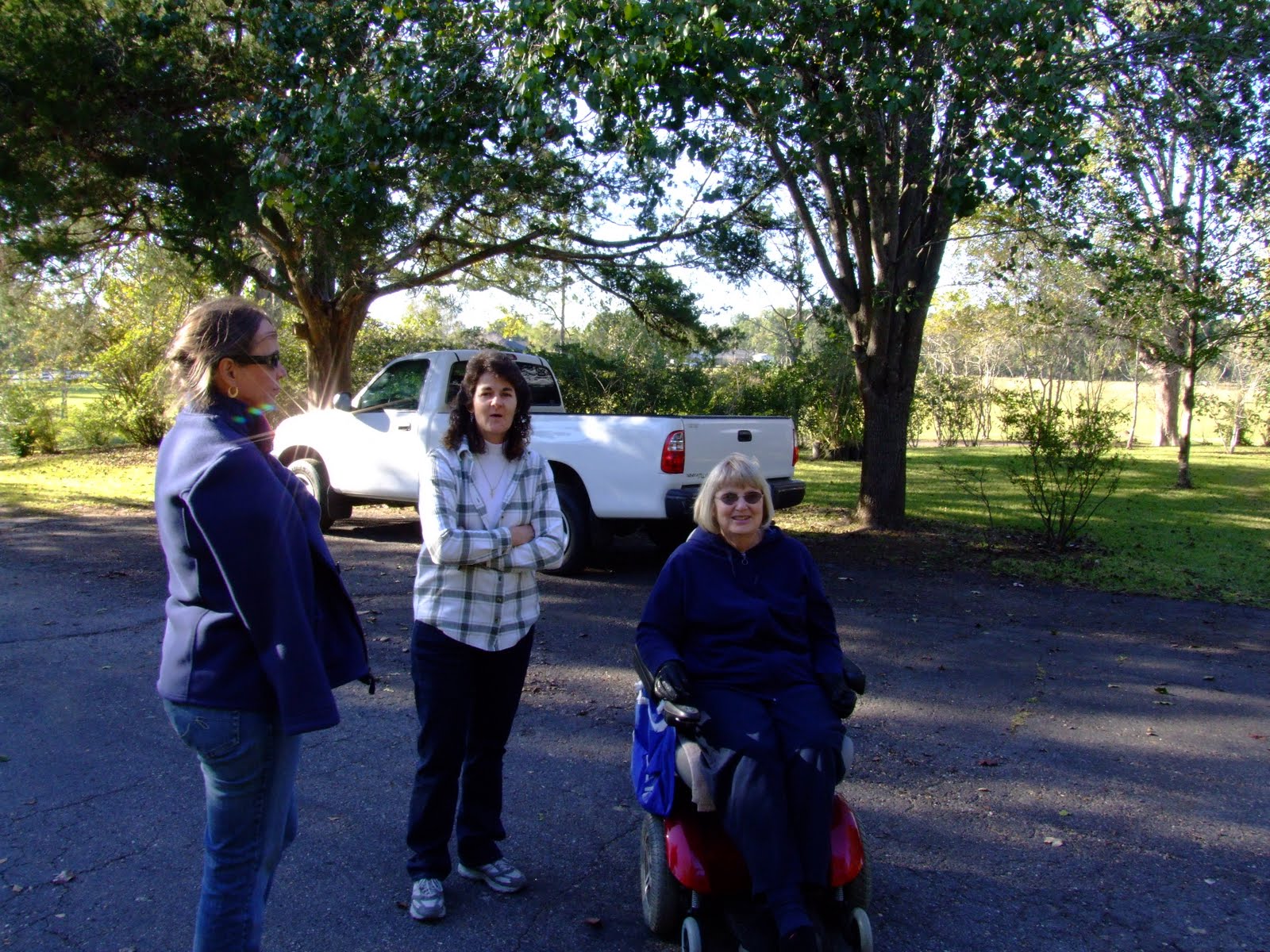
We ended up with them giving us a big bag of Pecan Nuts to take back to the trailer (this is big Pecan country, and this is the time to gather them). We then went and ate at the very posh Washington Steamboat Warehouse, which is a converted steamboat warehouse in Washington. We had a very nice, if slightly pricey, meal, Sally had Srimp Betsy (like a soup), I had Crawfish Etouffe and Camila had seafood Surprise (a pasta with a creamy seafood sauce).
Monday, October 25, 2010
Rosedown Plantation

On Saturday we decided to leave the big city and drive north into the Louisiana countryside and visit Rosedown Plantation, near to the historic town of St Francisville, which was interesting in itself.

Rosedown was a plantation which was built for Martha Washington (grandaughter of George Washington) and her husband in 1835, it remained in her family intil 1950, then passed on to others who restored it and finally sold it to the State Parks who have maintained it ever since. We had a very pleasant guided tour through the house, which was as it was in 1835, most of teh furniture and the wall coverings were imported from the North or direct from Europe, Here Sally is standing beside a giant four poster bed.

We then were able to wander the grounds, where we ate our packed lunch.
It is a traditional antibellum (pre civil war) planation house. Its most stunning feature is the avenue of live oak trees and its gardens. We had a lovely day there.

Saturday, October 23, 2010
Huey P Long
One of the most fascinating politicians I have never met. He was the Governor from 1928 to 1932, He was supposedly a very corrupt Governor, with many stories attached to his term in office. He was a very powerful man, who eventually was looking to run for President against Herbert Hoover.
He became very popular in Louisiana because he ordered the building of thousands of miles of roads, built the first bridges across the lower part of the Mississippi (named surprisingly the Huey P Long Bridge, we wrote about how scary this bridge is to cross when we came to New Orleans last year). He also opposed the power of Standard Oil (LA is very rich in oil) and removed the Poll Tax, yes you had to pay a poll tax if you wanted to vote, surprisingly few poor people voted in the state elections, white or black.
He was very unpopular amongst other politicians and Standard Oil, because he removed power from them and gave it to himself as well as enfranchising many poor people. He also sacked many hundreds of public officials and replaced them with his family, friends and people who had supported him in his campaign.
Arguably his biggest enemy was the President himself, as he had eyes on that office. He was appointed to the Senate (national) in 1930, but did not take up the post until he finished his governorship in 1932. He made many deals with people in Washington, pushing his doctrine that there should be wealth and work for all (remember this was at the height of the depression and the official line was to make drastic budget cuts), so powerful did he become in Washington that Franklin D Roosevelt was forced to create his 'Fair Deal' programme of public works and job creation, which was intended to cut the ground from under Long's feet, yet only succeeded in increasing his popularity.
In 1935 he was assassinated in a crowded corridor of the Capitol Building in 1935, supposedly by a Doctor Weiss. who was the son-in-law of a judge who had been removed by Long. Dr Weiss was shot dead at the scene by Long's security men, there were 61 bullets holes in him, they made sure that he was dead. Long died two days later. Weis's gun was not recovered at the scene, because he was not carrying a gun and it was found in his car! There was no Autopsy. Later (years later) forensic evidence showed that the gun was not the weapon that was used to assassinate Huey P Long. He was actually killed/murdered by his own security staff, for reasons unknown (though check on the enemies he had made). So Huey P Long was assassinated by his own men in his own building, before he could declare himself as a presidential candidate.
Many people think that had he lived he would have won the election in 1940 and been president during the war. Oh by the way his foreign policy was that he was an Isolationist - America should not involve itself with any foreigners.
There were some very interesting politics in those days. I urge you to read more abut him and his family on Wikipaedia and his official Bio page. The award winning book 'All The Kings Men' is a thinly disguised biography of him.
He became very popular in Louisiana because he ordered the building of thousands of miles of roads, built the first bridges across the lower part of the Mississippi (named surprisingly the Huey P Long Bridge, we wrote about how scary this bridge is to cross when we came to New Orleans last year). He also opposed the power of Standard Oil (LA is very rich in oil) and removed the Poll Tax, yes you had to pay a poll tax if you wanted to vote, surprisingly few poor people voted in the state elections, white or black.
He was very unpopular amongst other politicians and Standard Oil, because he removed power from them and gave it to himself as well as enfranchising many poor people. He also sacked many hundreds of public officials and replaced them with his family, friends and people who had supported him in his campaign.
Arguably his biggest enemy was the President himself, as he had eyes on that office. He was appointed to the Senate (national) in 1930, but did not take up the post until he finished his governorship in 1932. He made many deals with people in Washington, pushing his doctrine that there should be wealth and work for all (remember this was at the height of the depression and the official line was to make drastic budget cuts), so powerful did he become in Washington that Franklin D Roosevelt was forced to create his 'Fair Deal' programme of public works and job creation, which was intended to cut the ground from under Long's feet, yet only succeeded in increasing his popularity.
In 1935 he was assassinated in a crowded corridor of the Capitol Building in 1935, supposedly by a Doctor Weiss. who was the son-in-law of a judge who had been removed by Long. Dr Weiss was shot dead at the scene by Long's security men, there were 61 bullets holes in him, they made sure that he was dead. Long died two days later. Weis's gun was not recovered at the scene, because he was not carrying a gun and it was found in his car! There was no Autopsy. Later (years later) forensic evidence showed that the gun was not the weapon that was used to assassinate Huey P Long. He was actually killed/murdered by his own security staff, for reasons unknown (though check on the enemies he had made). So Huey P Long was assassinated by his own men in his own building, before he could declare himself as a presidential candidate.
Many people think that had he lived he would have won the election in 1940 and been president during the war. Oh by the way his foreign policy was that he was an Isolationist - America should not involve itself with any foreigners.
There were some very interesting politics in those days. I urge you to read more abut him and his family on Wikipaedia and his official Bio page. The award winning book 'All The Kings Men' is a thinly disguised biography of him.
Thursday, October 21, 2010
Baton Rouge! - The Red Stick!
No I do not know why they named the place 'Red Stick', but I am working on it.
On Friday morning we made a packed lunch and set off along the bank of the Mississippi going into Baton Rouge.
Our normal routine for a new place is to:
1 find the Tourist Information
2 Find out about parking regulations.
Well we couldn't find the TI, so we stopped outside City Hall to find out about parking regs. The information desk was deserted, but a Shoe Shine Boy was happy to tell me that Sally's blue badge would be OK to use in Baton Rouge. He also told me where the TI Office was, so we were able then to get ourselves organised.
Baton Rouge is the Capital of Louisiana, so it has the Capitol Building as well, which houses the two houses of representatives and the Senate for the State. Often they are styled on the Washington Capitol building, with a big dome. Not Baton Rouge. It has the Old Capitol Building, which is square and looks like a castle and the New Capitol Building, which is a skyscraper. The story of this skyscraper is intermingled with its most famous Governor, one Huey P Long. He was the Governor from 1928 to 1932, He was supposedly a very corrupt Governor, with many stories attached to his term in office.
Anyway, back to the Capitol Building. The building was built, surprise, surprise, by Huey P Long (no not personally) and completed in 1934. Closely modelled on the Chrysler and the Empire State Building, it is a tower 30 floors high and was finished in 14 months! We rode the elevator to the top where you get a stupendous view of - well swamp, from every direction the land is flat and swampy, but that's what Louisiana is. It is still far and a way the tallest building in Baton Rouge and dominates the skyline. So Huey P Long was assassinated by his own men in his own building, just before he could declare himself as a presidential candidate. There were some very interesting politics in those days.
After visiting the Capitol we went to the Louisiana State Museum which gave us a good idea of the history and importance of Louisiana. In particular we learned about the Louisiana Purchase, in Dec 1803 the fledgling US bought 600 million acres of land to the west of the Mississippi for $15 000 000 from the French, only months after Spain had given it to France after Napoleon had given the assurance that it would never leave French hands. There appears to have been a fair amount of skullduggery attached to this land acquisition. This doubled the territory owned by U.S. and gave it control of the whole of the Mississippi Basin.
Anyway enough history. Our poor brains were sizzling. We drove home (back to the trailer) and made a lovely meal of burger for Sally, while I had the other half of the pork chops with red beans and rice that I had brought back form Sammy's last night.
On Friday morning we made a packed lunch and set off along the bank of the Mississippi going into Baton Rouge.
Our normal routine for a new place is to:
1 find the Tourist Information
2 Find out about parking regulations.
Well we couldn't find the TI, so we stopped outside City Hall to find out about parking regs. The information desk was deserted, but a Shoe Shine Boy was happy to tell me that Sally's blue badge would be OK to use in Baton Rouge. He also told me where the TI Office was, so we were able then to get ourselves organised.
Baton Rouge is the Capital of Louisiana, so it has the Capitol Building as well, which houses the two houses of representatives and the Senate for the State. Often they are styled on the Washington Capitol building, with a big dome. Not Baton Rouge. It has the Old Capitol Building, which is square and looks like a castle and the New Capitol Building, which is a skyscraper. The story of this skyscraper is intermingled with its most famous Governor, one Huey P Long. He was the Governor from 1928 to 1932, He was supposedly a very corrupt Governor, with many stories attached to his term in office.
Anyway, back to the Capitol Building. The building was built, surprise, surprise, by Huey P Long (no not personally) and completed in 1934. Closely modelled on the Chrysler and the Empire State Building, it is a tower 30 floors high and was finished in 14 months! We rode the elevator to the top where you get a stupendous view of - well swamp, from every direction the land is flat and swampy, but that's what Louisiana is. It is still far and a way the tallest building in Baton Rouge and dominates the skyline. So Huey P Long was assassinated by his own men in his own building, just before he could declare himself as a presidential candidate. There were some very interesting politics in those days.
After visiting the Capitol we went to the Louisiana State Museum which gave us a good idea of the history and importance of Louisiana. In particular we learned about the Louisiana Purchase, in Dec 1803 the fledgling US bought 600 million acres of land to the west of the Mississippi for $15 000 000 from the French, only months after Spain had given it to France after Napoleon had given the assurance that it would never leave French hands. There appears to have been a fair amount of skullduggery attached to this land acquisition. This doubled the territory owned by U.S. and gave it control of the whole of the Mississippi Basin.
Anyway enough history. Our poor brains were sizzling. We drove home (back to the trailer) and made a lovely meal of burger for Sally, while I had the other half of the pork chops with red beans and rice that I had brought back form Sammy's last night.
Tuesday, October 19, 2010
The Trolley Song
Monday. It is a little know fact that New Orleans has electric trolleys (trams), Even less well known is that it is the oldest continuously operated trolley system in the world (1823). So today (Monday) is our chance to ride the trolley. 
We had intended to return to the Audobon District to wander through the park, and perhaps go to the zoo. However as we passed the trolley terminus at the Leonidas district Jim suggested we ride the trolley. Seemed like a good idea, so we parked the van and jumped aboard a waiting trolley. The Trolley we are on is known as the St Charles Trolley as it travels down S Carrollton and then swings east and travels through the Loyola Univ., Audubon, Uptown, Touro and Garden Districts, past the Lee Circle and terminates at Canal St. These areas were built in Victorian times and have lots of grand houses fronting on to St Charles Ave, which is a wide boulevard lined with massive live oaks. The trolleys travel on an Up and Down line in the central reser vation (US = Median)., so you can get a good view of all the houses we pass. As well as the Audubon Park and the Loyola University. Having taken the first part of the route, we jumped out at the start of St Charles Ave and bought ourselves a Stone Cold Ice Cream each. Stone Cold ice cream is a delicious ice cream, you choose the flavour and then choose what goes in to it, they then take your ingredients and blend them together with the ice cream. So I had Coffee with caramel and heath (dime , now Diem, bars) crushed in it. Sally found a dairy and wheat free Raspberry sorbet, which was very good. Jim had straight banana ice cream (no the bananas were not straight, the ice cream had nothing else in it) and Kathy had a green one, which could have been either mint of pistachio. Having had a break we hopped back on to another trolley and trolleyed right along St Charles Ave. We passed some wonderful big colonial houses, as well as some newer Art Deco houses. Many houses were decorated for Halloween. We had planned to go all the way to Canal St, but there were repairs being made to the track so we had to change from trolley to bus and it seemed to be a better idea just to get the trolley back, which is what we did. After this we were getting ready to eat, so instead of coming back to the trailer and cooking shrimp BBQ we went to a seafood restaurant called Bordreux's and has a seafood dinner, Sally had the dish of the day - rice and red beans with catfish, I had jumbo shrimp stuffed with crab. Both of them were delicious. After returning to the trailer we sat and watched Jim and Kath's home football (NFL) team the Jacksonville Jaguars lose badly to the Tennessee Titans. A great day.

We had intended to return to the Audobon District to wander through the park, and perhaps go to the zoo. However as we passed the trolley terminus at the Leonidas district Jim suggested we ride the trolley. Seemed like a good idea, so we parked the van and jumped aboard a waiting trolley. The Trolley we are on is known as the St Charles Trolley as it travels down S Carrollton and then swings east and travels through the Loyola Univ., Audubon, Uptown, Touro and Garden Districts, past the Lee Circle and terminates at Canal St. These areas were built in Victorian times and have lots of grand houses fronting on to St Charles Ave, which is a wide boulevard lined with massive live oaks. The trolleys travel on an Up and Down line in the central reser
 vation (US = Median)., so you can get a good view of all the houses we pass. As well as the Audubon Park and the Loyola University. Having taken the first part of the route, we jumped out at the start of St Charles Ave and bought ourselves a Stone Cold Ice Cream each. Stone Cold ice cream is a delicious ice cream, you choose the flavour and then choose what goes in to it, they then take your ingredients and blend them together with the ice cream. So I had Coffee with caramel and heath (dime , now Diem, bars) crushed in it. Sally found a dairy and wheat free Raspberry sorbet, which was very good. Jim had straight banana ice cream (no the bananas were not straight, the ice cream had nothing else in it) and Kathy had a green one, which could have been either mint of pistachio. Having had a break we hopped back on to another trolley and trolleyed right along St Charles Ave. We passed some wonderful big colonial houses, as well as some newer Art Deco houses. Many houses were decorated for Halloween. We had planned to go all the way to Canal St, but there were repairs being made to the track so we had to change from trolley to bus and it seemed to be a better idea just to get the trolley back, which is what we did. After this we were getting ready to eat, so instead of coming back to the trailer and cooking shrimp BBQ we went to a seafood restaurant called Bordreux's and has a seafood dinner, Sally had the dish of the day - rice and red beans with catfish, I had jumbo shrimp stuffed with crab. Both of them were delicious. After returning to the trailer we sat and watched Jim and Kath's home football (NFL) team the Jacksonville Jaguars lose badly to the Tennessee Titans. A great day.
Subscribe to:
Comments (Atom)